Wednesday, August 15, 2018

To Dog-Pile, In the Second Sense


Introductory Digression

Northerners say "dog-pile" while Southerners use the expression "pig-pile" -- apparently since 1880 -- when referring to the same concept.

Dictionary.com lets us know that the noun dog pile refers a thing that is "formed when a group of people jump on each other, often done as a children's game or in athletic celebrations."  The verb dog-pile, however, means "to gang up on a person in mass criticism."

I started to write this post with a sentence that began "I don't mean to dog-pile on the guy, BUT...".  Then I had second thoughts and I wondered if I was using the expression correctly.  

I was.


Continuing with the Actual Dog-Piling

I'm of course talking about "mass criticism" of our own Gary Sánchez.


Duque wrote this morning:

I'll admit it: I have permanent PTSD from the image of Sanchez jogging to first last month, in that horrifying loss, when he was thrown out on what should have been a game-tying infield hit. The Yankees made an excuse for him; they put him on the DL and blamed his hamstring. Well, I don't buy it. The guy's signature style of play has been to loaf. Frankly, it's why he fails to block so many pitches in the dirt: he simply doesn't throw himself into it. 
Our awesome commenter, who goes by "Doug K", made a brilliant comment the day after the game.  His comment ended as follows:

We can live with knuckleheads. We can live with overweight pitchers with rubber arms. We loved the Toe Show because that guy plays so far above his skill level if he wants to do a talk show in the dugout – go right ahead. He plays for keeps.
What the game does not tolerate is lack of hustle. 
Aaron Hicks busted his butt to not get thrown out at second. Game tying run. Team in a pennant race. Came up limping a little bit. Gave 100% 
Gary let down the team, the organization, and the game itself. They can’t get rid of him immediately. We all know this. But...
Next time a ball is hit to right on a tag play Judge will throw to the catcher. That’s the beauty and strength of the game. But he will no longer be throwing to a teammate. And that’s just sad. 
...And that's just great stuff, Mr. Doug.

While Duque and Doug K. were both traumatized by Sánchez' lollygagging with the game on the line, I blew a gasket at the way he handled a passed ball in the early innings.  I wrote:
If you look at the way he lackadaisically waddled after the passed ball, it had nothing to do with being injured. It simply didn't occur to him that the runner might go for it. Even if Severino had covered home instantly, there's no reason to let your opponent force you into a play at the plate like that. Severino's heated discussion with him in the dugout said it all.
Not as eloquent as Doug K or Duque, but those guys are tops.


Dog-pile Digression #2

With his "boy-I-sure-do-like-cookies" puffed jowls, has anyone else noticed that there's a passing resemblance between Gary S. and the cartoon character Baby Huey?
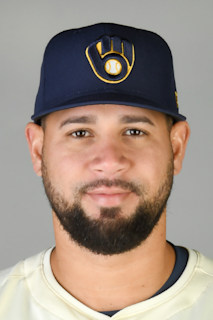
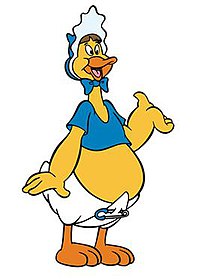

Watch the tape of that guy loping after the passed ball and you'll see what I mean.


Ok, Back on Topic
There was an article in yesterday's NY Post with an awkward "yes, we have no bananas" headline:
Is Gary Sanchez Not the Right Catcher for These Yankees?
With a headline like that, and still being PISSED about that game, I was predisposed to agree with everything the author might write.  All the same, I really wasn't ready -- at all -- for a single sentence in the article to go right up my nose sideways.  That sentence was:
The polarizing catcher spoke with the media Tuesday afternoon and said he has been watching as many of the Yankees’ games as his rehab schedule allows.
I mean, WHAT?

This guy is paid $620,400 per year by the Yankees and he's not even watching the games? Let alone playing in them?  I mean, he's a catcher, for crying out loud.  If he can't play, he should be watching his batterymates.  He should be looking at their mechanics, seeing if they're tipping their pitches (cough, Severino), and generally being a good teammate.  Which, apparently, he's not.

And PLEASE don't tell me, Gary, that your rehab is scheduled most nights at 7-10pm.  It's HOGWASH that you can't watch games because of rehab, unless by "rehab" you mean "lying poolside with fresh-cut cucumbers slices stuck to my closed eyelids."

And, even if your rehab is somehow scheduled during the middle of Yankee games .... record the freakin' games and watch them later.  Grrr.

It seems true that this guy has checked out, if he was ever checked in.


So, Duque, and Doug K, the NY Post and many others are dog-piling this guy and I don't mean to join in but -- sheesh -- they're paying him $620K and he can't even pitch in and help his teammates, even by watching television?

The Greatest Team What Ever Was, Part III

Back despite popular demand!  The Greatest Teams Ever Nominees, 1980s and '90s.

1984 Detroit Tigers 104-58 3 HOF—This team got off, I think, to the greatest start ever, going 16-1 and then 35-5 out of the gate.  They never looked back, sweeping the Royals in the ALCS and taking the Padres in five in the Series.

Statistically, it's a little difficult to see just why these guys were so good.  There were few real stars. The Bengals had plenty of depth, though it wasn't outstanding; fortunately they had Sparky Anderson along to use it to best advantage.

Mostly, they hit home runs—a league-leading 187—drew walks, and got good, steady (if unspectacular) pitching.   Lance Parrish hit 33 homers as catcher, they had their terrific, longtime second-short combo of Lou Whitaker and Alan Trammell, and a very dependable outfield of Larry Herndon, Chet Lemon, and Kirk Gibson.

Trammell hit .314 and won the Gold Glove but missed 23 games with an injury, which probably cost him the MVP (Though why he should be in the Hall and not his double-play partner, Whitaker, is beyond me; they're virtually the same player.  Hmm, I wonder what the reason could possibly be??)

Instead, that award went to the big surprise on this team, Guillermo "Willie" Hernandez, a journeyman middle reliever who suddenly blossomed as a closer, winning the Cy Young and MVP.  He headed a reliable pen that backed up a solid top three starting staff of Jack Morris, Dan Petry, and Milt Wilcox.

1986 New York Mets 108-54 1 HOF—The best young team ever. The Mets position players had a pretty normal average age of 28, but that was only because of the veterans Carter, Hernandez, and 37-year-old George Foster, and they got younger as they went along, jettisoning Foster in early August.

The pitching staff, though, averaged just 25.5, the youngest in the NL by two full years.  When you win your division by 21 1/2 games and you've got the youngest staff around, the future should be your oyster.  The fact that it was not, that these Mets would only win one more division title, is a blot on the escutcheon of their arrogant, often out-of-control manager, Davey Johnson.

Johnson believed avidly in encouraging the team's runaway carousing as a means of "bonding."  Instead, it helped send several of its key players into a spiral of addiction and dysfunction.  You'll note these Mets boast only one Hall-of-Famer, Gary Carter.  At the time, most observers would surely have thought there would be at least two or three more.

For 1986, though, they were a rampaging force, with a future MVP—Kevin Mitchell—coming off the bench, and a big five starting staff that has rarely been equaled, backed up by a deep bullpen.  The only real hole was at shortstop, with Rafael Santana, who would soon be banished to the Bronx (great).

This team had been built by Frank Cashen, who had also helped build some of the great Orioles teams of the 1970s.  And with a host of talent seemingly waiting in the wings—Gregg Jeffries, Dave Magadan, Kevin Elster, a still emerging Howard Johnson, and later David Cone—how could anything it NOT have been a dynasty?  All one can say is...Mets.

1990 Oakland Athletics 103-59 3 HOF—The Bash Brothers and Co. seemed unstoppable, coasting to the AL West title and sweeping the BoSox in the ALCS—before suddenly coming acropper against the Reds and their "Nasty Boys" bullpen in the Series.

This A's team had an incredible collection of veterans, many of them hitting their stride together.  Rickey Henderson, at 31, hit .325, stole 65 bases, and finally won the MVP he'd probably already deserved two or three of.  Bob Welch won 27 games and took the Cy Young.  Dave Stewart won 21.  Eckersley had another great season as closer, with 48 saves and a 0.61 ERA, heading a terrific bullpen.  Carney Lansford hit .336 at third, Jose Canseco hit 37 homers, and Mark McGwire hit 39.

And on hand as well were Willie Randolph, Terry Steinbach, Harold Baines, Dave Henderson, Walt Weiss, Willie McGee, and a cast of thousands.

Yet there is a permanent cloud over this team, and its 1988-89 predecessors, and it isn't just about their occasional October meltdowns.  The question is, how juiced were they?  Maybe not a whole lot, not yet; McGwire, for instance, hit only .235.  But the cheating had started, and it would spread.

1993 Toronto Blue Jays 95-67 4 HOF—The 1992 version of this team had somewhat better pitching, especially after it picked up David Cone late in the season.  But the 1993 squad had so many incredible, individual performances that I have to go with it.

John Olerud hit .366 at first, in one of the all-time great infields.  Robby Alomar hit .326 with 55 stolen bases and won a Gold Glove at second, and Tony Fernandez hit .306 at short.  Paul Molitor, mostly a DH, hit .332 at the age of 36, and Joe Carter slugged 33 homers, and another to clinch the World Series.  There was also Devon White catching everything in centerfield, and the ubiquitous Rickey Henderson, just to shore things up.

The pitching, as mentioned, was less than stellar.  Pat Hentgen won 19 games, but with an ERA of nearly 4.  The pen was better, with Duane Ward doing yeoman's work as closer, but even that wasn't spectacular.  Still, this team breezed past the White Sox and the Phillies in the postseason, for its second straight title.

1995 Atlanta Braves 90-54 (strike-shortened season) 5 HOF—A pitching team, mostly, this Braves edition alone, of all its winners from 1991-2005, put it altogether to capture a ring.

What's left to say about Maddux, Smoltz, and Glavine?  And for a change, they had a solid bullpen behind them, headed by Mark Wohlers, who fortunately chose the following year, against us, to give it up big time.

Elsewhere, Ryan Klesko had a career year in the outfield, Fred McGriff hit a consistent 27 homers at first, Javy Lopez and Chipper Jones were already coming into their own at catcher and third, and David Justice as usual underperformed but still hit 24 dingers.  There was also a strong bench although this team, as usual, had little in the way of middle infielders.

But hey, it went 11-3 in the first ever, three-round playoffs, knocking off a truly great-hitting Indians team in the World Series.

So...what is The Greatest Team What Ever Was?  Tune in tomorrow!  (Or Friday, tomorrow is a bear!  I know you can't wait.)


Seattle v. Oakland, Happ v. Sevy, Romine v. Sanchez, Bird v. Nobody

Hot scoop: Led by first-baseman - yes, 1B - Jogginson Cano, (who notched a single!), the Seattle Mariners last night lost to Oakland, 3-2, dimming their hopes for that elusive, 2018 wild card berth. The Yankee "wild card magic number" - wins coupled with Mariner losses - has dropped to 39. We lead the Joggers by six in the loss column. 

Over the next two nights, with Oakland hosting Seattle, we can be fat, drunk and stupid against the Rays. No matter what happens, we cannot lose ground. This is like lice vs. crabs, acne vs. psoriasis, shingles vs. - wait, take it from Terry Bradshaw: You don't want shingles! But you get the picture: Oakland v. Seattle... the enemy of my enemy is my friend. 

And if we can sweep the Rays - ...to dream the impossible dream, to fight the unbeatable foe... - we can put space between us and the AL West. Obviously, if the Yankees fail to win the Wild Card home field advantage, Boone will be fired, and this season will suck. But no matter where the game is played, let's face the reality: 2018 is going to come down to nine innings. That became clear two weekends ago, and no hot streak against tomato cans can change that. Our year now rests on one October night, and we don't have a clue who our starting pitcher should be.

Clearly, Boone will go with the the best Yankee pitcher at the time. Luis Severino is no longer an ace, and Masahiro Tanaka hasn't been one in two years. If the game were tomorrow, we'd pick J.A. Happ, hands down. A bigger question: Who would catch?

I'd vote for Austin Romine, who has outperformed Gary Sanchez at nearly every level. Last night, Michael Kay blathered how the Yankees have missed Sanchez' big bat. He was referring to the 2016 Sanchez, not the one we've seen this year. Check the stat lines.

Romine:  182 at bats, 8 HR, 35 RBIs, .269
Sanchez: 245 at bats, 14 HR, 42 RBIs, .188.


Give Romine another 60 ABs, and he'd have the same RBI totals as Sanchez. Moreover, he strikes out less (67 for Sanchez, 43 for Romine), and we all know Gary's inability to block pitches - and his refusal to run after them. 

I'll admit it: I have permanent PTSD from the image of Sanchez jogging to first last month, in that horrifying loss, when he was thrown out on what should have been a game-tying infield hit. The Yankees made an excuse for him; they put him on the DL and blamed his hamstring. Well, I don't buy it. The guy's signature style of play has been to loaf. Frankly, it's why he fails to block so many pitches in the dirt: he simply doesn't throw himself into it. 

I get why the Yankees don't criticize him (as Joe Girardi did last year.) There's a far-flung chance that he'll get hot for a week or two in September. Still, I hope Sanchez is part of a trade next winter. He needs to play in a small market city where his team contends every five years. Once he's over 30 and hungry for a post-season, you better believe he'll run out grounders. Then, he'll magically reduce the number of passed balls. 

Other idle thoughts:

It would really be nice for Aroldis Chapman to have a 1-2-3 outing. Just one. You still have a sense of dread, that the dam can break at any time.

Realistically, the Yankees have no other option at 1B than Greg Bird. Luke Voit looks a notch below Tyler Austin, and Mike Ford - currently hot at Scranton - bats left-handed, so there can be no platoon. Ford deserves a shot, but the Yankees will never give it. Why? He was never drafted. They signed him out of the Cape Cod League, and he doesn't have the pedigree. 

Neil Walker has done nicely in RF. But he is a ticking time bomb. One of these days, a ball in the gap is going to have him on a collision course with Aaron Hicks. You can't stick a career infielder in right field without eventually paying the price. 


The Greatest Team What Ever Was, Part II

Okay, time for our 1960s and '70s nominees!

1961 New York Yankees 109-53 3 HOF—Sure, the stats are probably inflated by the fact that it was an expansion year in the AL. But this Yankees team still set a record with 240 home runs. The M & M Boys hit 115 between them, Skowron hit 28, Yogi hit 22, Elston Howard and Johnny Blanchard each hit 21 (and Howard batted .348).  Tony Kubek showed warning track power with 38 doubles.

It was also an excellent fielding team, with one of the best infields in NYY history anchored by perennial Gold Gloves Bobby Richardson at second, and Clete Boyer at third.

This team often gets downgraded a little for supposedly not having enough bench. But it outpaced a terrific Tigers team despite losing Mantle for much of September, and it beat Frank Robinson's Reds in five in the Series with Mantle making only a couple pinch-hitting appearances and Maris mired in a terrible slump.  In the final game, the Yanks won 13-5, with Hector Lopez driving in five runs, and Bud Daley pitching nearly seven innings of relief for the win.

(And in a great what-if:  this team only did not have Rocky Colavito and Carl Yastrzemski because of the arrogance of Yankees scouts. Deron Johnson might also have had more than a cup of coffee, if needed.)

A more valid criticism is the depth of the pitching. Whitey Ford won the Cy Young and broke Babe Ruth's scoreless innings' record in the Series, but after that you have essentially three effective starters, and a terrific reliever in Luis Arroyo—and little more. The 1963 Yankees get short shrift because they were swept in the Series by the Dodgers, but it still won 104 games despite devastating injuries to Mantle and Maris, and you get the feeling that its superior staff might have got it past this team.

1970 Baltimore Orioles 108-54 4 HOF—The 1969 and 1971 teams are both a little better statistically, but I think this version of the amazing Orioles teams at the time was better balanced.

The O's won the last 11 games of the regular season, then swept a very good Twins team in the ALCS, and came within one pitch of sweeping the first, Big Red Machine—18 wins in 19 games to finish the year as champs. The Orioles had a terrific fielding infield, with Mark Belanger and B. Robby on the left side, an outstanding, all-around outfield, and dominant starting pitchers, with Jim Palmer winning 20 games, and Mike Cuellar and Dave McNally EACH winning 24.

The pen was not overwhelming but it was deep, and on the bench were a young Bobby Grich, Terry Crowley, and Merv Rettemund, the team's best hitter, at .322.  But above all, the Orioles were just a tremendous organization, top to bottom, producing player after player who was terrific on fundamentals, and one of the greatest managers of all time in Earl Weaver.

Weaver's doctrine of "pitching and three-run homers" generally worked well, but made this team a little vulnerable when it didn't. Hence their losses to hot pitching teams in the 1969 and 1971 World Series.

1973 Oakland Athletics 94-68 4 HOF—The centerpiece of the only team besides the New York Yankees ever to win three consecutive World Series. And again, compared to the 1972 and 1974 editions, it's mostly go-pick-'em.

These teams featured an excellent shortstop in Bert Campaneris, a slugger who loved the spotlight in Reggie Jackson (the 1973 MVP), and a ton of useful lug nuts, assembled and re-assembled almost inning by inning by another HOF manager, Dick Williams. The pitching was always lights-out; in 1973, Catfish Hunter, Ken Holtzman, and Vida Blue each won over 20 games, and a seemingly bottomless bullpen was led by HOF Rollie Fingers.

The A's didn't have better records, I think, because they were rarely pushed in a week division, and seemed to be saving themselves for the postseason—or maybe they were just lying in the weeds.  They seemed to thrive on strife, brawling and feuding, but always brought together in mutual hatred of their owner, Charlie O. Finley.

1976 Cincinnati Reds 102-60 4 HOF—The 1975 World Champs had better pitching, all in all, but they only won the Series against a Red Sox team (playing without an injured Jim Rice) because of a terrible call and Bill Lee.

The 1976 team never seemed seriously challenged.  It not only finished 10 games ahead of a good Dodgers squad, but swept both the Phillies and the Yankees in the postseason. Considering position players alone, this was the greatest team in the 1947-1999 era. At every spot was someone with at least three or four top skills.

Joe Morgan, who won his second straight MVP, was one of the all-time greats. Tony Perez was a HOF slugger at first, George Foster and Ken Griffey, Sr., were outstanding hitters in the outfield, and Cesar Geronimo and Dave Concepcion were Gold Gloves—and good hitters—at center and short. Morgan and Johnny Bench picked up two more Gold Gloves at second and catcher. Bench had an off-year at the plate—but made it up by hitting .533 and winning the Series MVP.

The bench was also superb, including future Gold Glover Doug Flynn, and Dan Driessen.  Given a chance to play as DH in the Series, Driessen hit .357, with a 1.152 OPS.

The team's weakness was pitching. None of the starters struck fear in the hearts of anyone, save for the oft-injured Don Gullett. But there was plenty of relief, and a very smart manager, Sparky "Dr. Hook" Anderson, who was not afraid to use it.

1977 New York Yankees 100-62 2 HOF—I loved this team, which handicapped itself by having a sociopath for a manager, and indulging in a seemingly endless series of idiotic, locker room fights.  It also took terrible injuries that might have finished a lesser team, losing both established stars such as Catfish Hunter and Ken Holtzman, and projected young stars such as Mickey Klutts, who was supposed to play shortstop after hitting .325 in Triple-A, and Gil Patterson, a young pitcher some of us still mourn.

These Yanks just brushed it off and kept on coming.  Fortunately, this team had a tremendous GM (with the patience of Job) in Gabe Paul, who kept sending in fresh troops, while insisting on hanging onto players such as Ron Guidry, against considerable pressure.

The Yanks had a tremendous fielding infield with Chambliss, Randolph, Dent, and Nettles, and terrific outfield hitters, in Reggie, Rivers (who hit a career-best .326), and Lou Piniella.  Munson had his third straight, 100-plus ribbies, .300-plus average season behind the plate.  There was also terrific depth, with Roy White able to platoon with Piniella, and hulking Cliff Johnson not only coming off the bench to hit bombs, but also do some catching. Poor George Zeber was named the best rookie in the spring, hit .323 with power, and only got 75 at-bats as a utility infielder.

The pitching was also outstanding, with Guidry, Mike Torrez, Ed Figueroa, and Don Gullett starting, and Sparky Lyle and Dick Tidrow leading a gutsy bullpen. Lyle won the Cy Young.

This was a team that could beat you in a hundred ways.  They could "go long and go short"—beat you both in a short series and the long season, something increasingly important in the playoff era.  They hit homers, stole bases, and pitched lights out.  The question of whether they were better than the 1978 Yankees is a tough one; the league that year was probably better.  But the 1977 squad beat down a very good Boston group, took KC even though Martin refused to start Reggie in the final game, and then drubbed the Dodgers while the Bronx was burning.

Next up:  The 1980s and '90s!


Tuesday, August 14, 2018

The Greatest Team What Ever Was, Part I

All right, in order to distract us from a certain, ongoing collapse, and in conjunction with the Yankees' honoring of the 1998 team (blessed be its name) this coming weekend, I thought we should have a look at determining The Greatest Baseball Team What Ever Was.

Apologies to Bill James for stealing the title.  James seems to think the title belongs to the 1927 Yankees and you know, it's hard to disagree with whatever Bill James thinks when it comes to baseball. Many others go for the 1939 Yankees—and interestingly, I believe the very first Old Timers' Day game was between the veterans of the 1927 team and the 1939 team, to honor Lou Gehrig, the only man on both, at the memorable "day" given him on July 4th, 1939.

As for me...I ain't buyin' it.

To start, we should narrow this down.  I don't think any team before the advent of the "live ball"—or more aptly, the "Ball What Hasn't Got Spit, Elm Juice, Vaseline and All Kinds of Other Shit All Over It" era, that began in 1920.  The other forms of baseball played before then were just too different to effectively compare.

For that matter, I would eliminate all teams before 1947, the first time that black people, Asians, and Hispanics—including those not of "pure Castilian blood"—were allowed to play the major league game, in the modern era.

Finally, I would also eliminate all of baseball AFTER 1999, when to me, the game became just too soaked in juice to really judge it against other eras (yes, J.D. Martinez, we're looking at you).  "Better Baseball Through Chemistry" should not be what this is about.

In other words, we're really deciding the best team over 53 seasons, 1947-1999, the height of the game as it was and should be played.

The contenders, as far as I'm concerned, for the 1940s and '50s:

1948 Cleveland Indians 97-58, 6 HOF—Beat out superb Yankees and Red Sox teams, then took Spahn and Sain's Braves in six.  Terrific fielding-and-slugging infield of Eddie Robinson, Flash Gordon, Ken Keltner, and player-manager Lou Boudreau, who hit .355 and won the MVP.  At catcher was Jim Hegan, a weak hitter but a great fielder.  The outfield was spottier, but still had Larry Doby, first (known) black player in the AL, who hit .301, and Dale Mitchell, who batted .336, albeit without much speed or power.

The pitching staff boasted starters Bob Feller, Bob Lemon, and kunckleballing sensation Gene Bearden, whom the Yankees had foolishly traded to them.  The bullpen was mostly little-known but very deep, including 41- or 42- or even-older- Satchel Paige, who also threw two shutouts in spot starts.

1950 New York Yankees 98-56 6 HOF—Blew off a tough Detroit squad and a Boston wrecking crew that was the last major-league squad to ever hit over .300 as a team, then made quick work of the Phillies' "Whiz Kids" in the World Series.

Featured a lot of strength up the middle, with Rizzuto having a career year and winning the MVP; Berra having a career year and missing out on what should have been his first MVP, and DiMaggio having his last great season in center.  The rest of the infield was spottier, but Bauer and Woodling had terrific years in the outfield, and there was great depth, as usual with the Yankees teams of this era—along with the greatest manager of all time to handle it.

The pitching staff had the great Reynolds-Raschi-Lopat triumvirate up top, and when Tommy Byrne founded, Whitey Ford came up and went 9-1, and won a World Series game.  The pen was as iffy as it is right now for the Yanks, with Joe Page having a wretched season, but Reynolds made 6 relief appearances, and Ford, eight.

1953 Brooklyn Dodgers 105-49 4 HOF (and as to why Gil Hodges isn't there, your guess is as good as mine)—The Best of the Bums, with MVP Roy Campanella behind the plate, Hodges having a near-career year at first, Gilliam and Pee Wee up the middle, premier gloveman Billy Cox on third, and 34-year-old Jackie Robinson enjoying his last great year, mostly in the outfield.  There he was joined by Duke Snider, who hit .336 with 42 homers, and Carl Furillo, he of the rifle arm, who led the NL in hitting at .344.

But the Dodgers fell down when it came to pitching, with little that was consistent after Carl Erskine. Built for their bandbox of a ballpark, they were only 45-32 on the road, and after a blazing 55-18 finish on the year, lost the Series in six to...

1953 New York Yankees 99-52 6 HOF—Won the AL in a walk, then beat the Boys of Summer.  Much the same as the 1950 team, only with a better all-around infield, and with Mantle replacing DiMag in center (though injuries limited him to 127 games).  The Chairman of the Board rejoined the Triumvirate after two years in the service, and had a terrific season.  The bullpen was deeper than in 1950, and led by Johnny Sain, who also spot-started and finished with 14 wins and 7 saves.

1954 Cleveland Indians 111-43 6 HOF—All-time great bottom feeders, they set a then-AL-record with 111 wins, but were only 22-22 against the next two best AL teams, the Yanks and ChiSox. Unheralded second baseman Bobby Avila won the batting crown, Doby had another excellent season with 32 homers and 126 ribbies, and Al Rosen hit 24 homers and batted .302 at third.  Very savvy manager in Al Lopez.

But mostly, this team was about pitching.  Its ERA was 2.78, almost a full run below the league ERA.  With Bob Lemon, Early Wynn, and Mike Garcia in the rotation, Feller was the No. 5 starter, and Hal Newhouser was in the very deep bullpen.

They were swept in the World Series by the Giants, though—and nobody was all that surprised.  The two teams had played each other repeatedly, coming north in the spring, and the Giants had won most of the time then, too.  May their fate presage that of the 2018 Red Sox!

1956 New York Yankees 97-57 6 HOF—Mantle's Triple Crown year, along with a career-year from Skowron at first, a superb season for versatile Gil McDougald taking over from the Scooter at short, and another great season from Berra behind the plate.  Stengel mixed and matched platoons of mediocre reserves incredibly well.

He also managed a deep but fragile pitching staff as probably no manager ever has, before or since.  Every pitcher made at least one relief appearance, and 10 made starts.  Ford had one of his best seasons.  The team coasted to the pennant, then edged the Dodgers in the last of the Brooklyn-NY series, featuring Don Larsen's perfect game.

1957 Milwaukee Braves 95-59 3 HOF—Rolled a very talented National League. The year featured Henry Aaron's one MVP season, and the Braves overcame an injury that cost the very talented Billy Bruton almost half a season in the outfield.

Ageless Warren Spahn led a very strong, four-man pitching staff, though the bullpen was rather spotty.  Former Yankee Lew Burdette won three games to take home the Series against his former team, but if not for an injury to Mantle (when Red Schoendienst deliberately sat on him at second) and the first, highly dubious "shoe polish" call, the Braves could easily have been swept.

Next up:  The 1960s and '70s!


Visualize The Leaks

Brian Cashman surveys the trades he made through the July 31 deadline.

He now assesses the 17th ranked farm system in minor league baseball ( and fading).


And he discovers that we have no players remaining with " high prospects."

We have no catchers at all.  No first basemen.  No outfielders.  No pitchers.

And the Yankee clipper ship is nose to the ground.

Awaiting the return of hard hitting, rock-gloved Jesus Sanchez.

Bums of the month:

1.  Torres
2.  Bird
3.  Peterson
4.  Voit
5.  El Chappo
5.  Gray
6.  Severino
7.  The Baltimore lefty
8.  Rothschild
9.  Boone
10.  Cashman
11.  Cole

The Coast Guard is busy with real problems.  Learn to swim.

With seven weeks left, leaks are forming in the Yankee barge

Well, now we know if Zach Britton will revise his dominant, all-world form of 2016. He won't. In fact, he's borderline awful, and because we surrendered so much to get him, we have no choice to keep wheeling him out and watching the fireworks. 

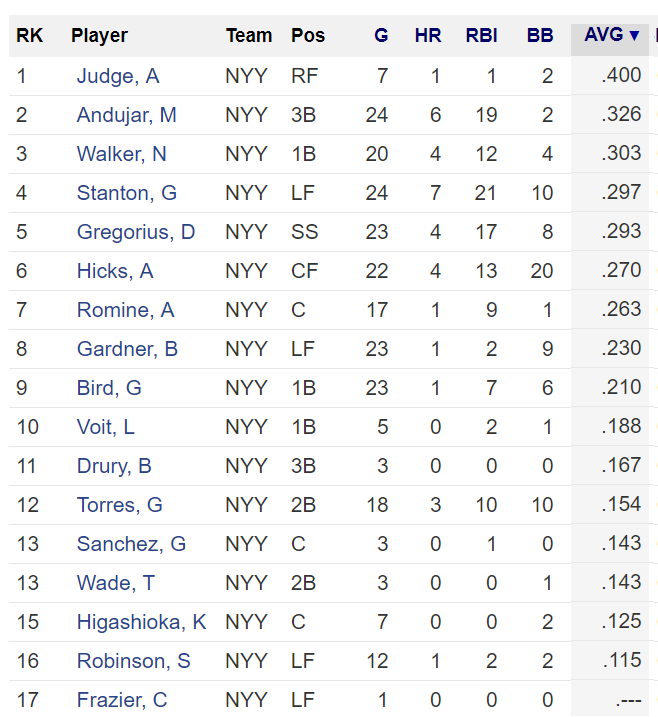
We are still learning about Gleyber Torres' attention span, which comes and goes. It's still not clear how low his batting average will fall before reaching bedrock. Over the last 30 days, he is hitting .154 and playing dismally in the field. That talk about Rookie of the Year? Not anymore.

We're getting a crash course in Miguel Andujar's defense, which falls somewhere between Bill Buckner and one of those immobile billboards outside Ebbing, Missouri. Two months ago, he looked like a future Yankee touchstone, enough to quell talks about Manny Machado. Now, he just looks like a stone. Or maybe a first-baseman, which might not be a bad thing because...

Ahh, crap, we're also learning about Greg Bird. For a while, we told ourselves he was back, breaking out and ready to become a star. Then, the world intervened. Over the last 30 days, he's hitting .210, and the Yankees are quietly looking for platoon options. (Though I think we also learned about Luke Voit.) 

Luis Severino? Still waiting. Gary Sanchez? Flip a coin. Aroldis Chapman? Let's not go there.

Here are the batting stats for the last 30 days.

As for pitching? Check out our "vaunted" bullpen over the last 30.


Remember when Domingo German showed so much promise? When was that, two years ago? Three? No... just two months? Where have all the flowers gone? What happened to that bullpen? The last two weeks have brought out more revelations than Omarosa's tapes. 

And this we know...

1. They can lose to anybody, regardless of how bad the other team is.

2. For a highly touted bullpen, they cannot hold any lead. 

3. There is no help coming from the minors. 

4. They are one more injury away from catastrophe. Imagine a tweaked gonad by Giancarlo, or Didi, or Hicks... we would be done.

It's a learning curve, right? Well, we have learned a lot. Come October, we may have to learn to love football. 

Monday, August 13, 2018

Ruh-roh


Just a day after pitching a nice game, CC is placed on the DL for reasons unknown.


Who exactly is 33-year-old George Kontos and why isn't he Justus Sheffield?


UPDATE: The injury is being called "right knee inflammation".

BIG UPDATE: In a related roster move, Ronald Torreyes is back!


Unintended Consequences

I will be the first to admit that I was against the idea of a wild card team, period. It seemed to me to fatally undermine the great accomplishment of winning the Long Season.

If the purity of the World Series had already been diluted since the instigation of league championships in 1969, well, at least every team in the playoffs had to finish first in something over baseball's 162-game schedule, unmatched in any league and any sport, anywhere in the world.

Even if it meant expanding, I wanted to have first-place teams only, in the postseason.

Well, the wild card put paid to that. It also enabled Boston to have its infamous second crack at us back in 2004, leading to the worst single moment in Yankees history. But I have to admit, it did keep a lot more teams in contention most years, including us, and created a sort of secondary pennant race.

Of course, the infamous corporate creation known as "MLB" could never leave well enough alone. One wild card worked out? Why, how about two?

On the surface, it didn't seem like such a bad idea. While a special, single wild-card game might signify nothing in and of itself, it at least penalized whoever won enough to give a real boost to finishing first.

But now, here in our seventh season of the double wild card, we see what it has led to:  the NBA-ization of the major leagues.

Right now, in the American League, at least, over half the teams are tanking, looking to get so low they can't help but get better. (It's little better in the senior circuit.) Those teams that are left in contention, meanwhile, will likely spend the rest of the season cakewalking home, gearing everything toward preparing for the playoffs which—as in the NBA, and the NHL, are the "real" season.

The only thing resembling a race right now is whether Seattle or Oakland will win out for that precious, second wild card spot. If the Yankees' bullpen continues to perform its Daring Young Men on the Flying Trapeze Act, this may change in a hurry.

But even so, 9 teams in the league, including the whole of the AL Central after Cleveland, will be looking to get down, get way down, and maybe cause a little mischief here and there.  Wreck a contender's pitching staff, cause an injury, etc.

Almost from the beginning, the big four of the league, Boston, Houston, the Indians, and the Yankees, have sprinted away from everyone else, in the classic style of the Warriors, the LeBrons, Houston, Boston, etc., over in hoopland.

This is probably fine with "MLB," which has for many years considered the NBA to be its role model, right down to grandiose plans to expand on a global scale, and the elevation of marketing above all. But it makes for bad baseball, and waning fan interest.

"Come see us three-to-five years from now, when we're back," much of the sport now says to its fans, a sort of prison-term advertising.  "Forget all this crap, the season starts in October," even the contenders have to say.

Hey, I'll be as thrilled as anyone if, say, the Yankees get all their guys back, brush off months of erratic, sloppy play, and somehow ruin the Boston Pilgrims' season in a best-of-five series. But that won't tell us a damned thing about what the best team was this year.

It will, instead, be an NBA finish, decided by who's hot and who's not, whose injuries hit early, and whose hit late.

And of course, what will be MLB's answer to this? Why, another wild card, I'm sure, and then another...


The Redsocks cannot stay this hot

This weekend, Boston once again swept their sad, platonic stooges from Baltimore. Over the 2018 season, the Redsocks are now 14-2 against the miserable, ever-tanking O's. Fourteen and two. If not for Drew Pomeranz, who lost both games, they'd be chasing a full-season sweep. Fourteen and two. Every year, we wonder how vengeful Buck Showalter will seek to hurt the Yankees, for which his hatred burns hotter than a billion suns. Now, we know. Fourteen and two. Fourteen and Drew.

Buck will see the Redsocks three more times, a series in Fenway, the second-to-last weekend of the season. The O's represent Boston's insurance policy against a September dive-bomb. As long as Drew Pomeranz doesn't pitch, the Redsocks will crush Showalter's Shipwrecks and head to 17-2. Seventeen and two. The fact is, Robert Mueller should investigate Showalter for meddling in the AL East. This is collusion.

But let's dismiss talk of a divisional race. That ship has sailed. Boston leads us by eight games in the loss column, and the Yankees will not catch them, no matter how many tomato cans populate our August schedule. (The rest of the month is all Del Monte, diced and stewed.) But take a look at these numbers since the all-star break, and tell me if Boston can stay this hot forever.


If Betts, Benintendi and JD Martinez remain the Holy Trinity, and Boston's pitching stays strong - (aside from the great Pomeranz) - the Redsocks could become the winningest regular season team in history. They are chasing immortality in the regular season. They are also peaking in August, two months before the playoffs. Steve Pearce is not the Second Coming of Mark McGwire, and Jackie Bradley Jr. must eventually return to Atlantis without his oxygen tank. JD Martinez has not played a full, healthy season in three years. 

Right now, the Yankees simply must whip the tomatoes and keep the Wild Card home field advantage. (Magic number: 43.) The one-game season is a sick joke, but if the Yankees can win it, they'll head to Boston in a best-of-five series,  knowing that, while we might be playing our best ball of 2018, there's no chance Boston will. They're peaking now, against Buck's Boners. Maybe old Showalter outsmarted himself, after all.

Sunday, August 12, 2018

Right now, no Yankee lead is safe, and the ninth inning has become The Abyss

It's a familiar picture: Sweat droplets leaping from the brim of Aroldis Chapman's cap, like mice fleeing a shipwreck, as our all-star closer stares into The Abyss. He is lost inside some delirium. El Chapo has walked the bases full, put the tying run in scoring position, with pitches so far out of the zone that Austin Romine had to stand to snare a few. He's hit a batter. Romine jogs out to the mound, and now here comes Larry "the House of" Rothschild, waddling out to dispense incredible wisdom such as, "Throw a fuckin' strike, for kricesake." Somebody - the last Yankee pitcher on the roster, a Shreve, a Cole or a Holder - is warming in the pen. But it's too late. Shoveling gum into his mouth, Aaron Boone is facing a firing squad. Five minutes ago, the Yankees had this game on ice. Now, chaos has arrived. Everything is in peril.  

It's the new normal: a heart attack ninth, regardless of the Yankee lead. And here's scariest part: Often, for Chappy to escape, opposing batters must swing at bad pitches. If you're facing a smart team - say, Boston, as opposed to cream puffs - good luck with that. Any veteran batter who can flick a foul ball or two will win a walk. And if this happens to be the playoffs, forget it.

Wonder what The Abyss looks like? Stare into Chapman's recent stats:


Some might see hope: Chapman has endured meltdowns before. And come October, if the Yankees reach a meaningful post-season, he will either be unhittable, or a complete stooge. The Yankees have him for three more years - (he has an opt-out clause after this season, but at $17 million per, I kinda doubt he'll invoke it) - and it's hard to imagine three more ragged Augusts like this.

So, naturally... the Yankiverse yesterday received a double-dose of nightmare: The wheels fell off Zach Britton. After retiring the first two batters in the seventh, he gave up an infield hit, a single, and then contracted Chapmanitis: he couldn't throw a strike. Britton was the big Yankee acquisition last month. We arguably gave up as much for him as for JA Happ and Lance Lynn, combined. 

And now we have Abyss No. 2 - Britton's recent numbers.


The worst part of these abysses? Come tomorrow, it won't matter that Britton and Chapman appear to be milk carton lost children. If the Yankees lead in the seventh, Boone will launch his countdown clock, starting with Britton, flowing into Betances, and finishing with El Chapo. It was supposed to be a psychological barrier to the opposition: the notion that three shutdown relievers are on the way. Now, it's The Abyss, and we are staring into it far too often to think that anything - including a post-season - is assured.

Saturday, August 11, 2018

The Yankees need to start pondering the possibility of life without Aaron Judge

It's now 17 days since Aaron Judge cracked his forepaw on a KC purpose pitch - an injury that was supposed to cost him about three weeks. But according to the Internet, Judge still feels pain and cannot swing a bat. Considering that he'll need a rehab stint in the minors, he could be gone until September. Moreover, ailing wrists can reduce sluggers into slumpers - (see Teixiera, Mark) - and the Yankees cannot afford to have Judge return and be ineffective or - worst case scenario - re-aggravate a minor injury into long-term consequences.

Still, the most amazing part of this story is that Cooperstown Cashman has sat on his own wrists, doing nothing to fill the void. (Or the Voit.)

Last night, 33-year-old Shane Robinson appeared in his 12th game of 2018, mostly coming since Judge's injury. It's hard not to root for Robinson, who has kicked around the minor league scrub-lands since 2006 and, at 5'9," looks like Queen Margaret inside a batting helmet. His signature Yankee moment - a seemingly pivotal BB against Boston last Sunday - was later obliterated by Aroldis Chapman's meltdown. (Considering Chapman's psycho-implosions, it's starting to become clear why he once shot-up his garage door; the man should not be allowed to possess firearms.) After his 0-3 last night, Robinson is hitting .148, without power, a non-entity who hits ninth.

The upstairs reference to "Voit" refers to Luke Voit, a first-baseman whom the Yankees obtained from St. Louis during a dizzying set of pre-deadline deals that ended Tyler Austin's time on the Scranton merry-go-round. I recognize that you need two teams to cut a deal, and no GM ever wants to be accused of helping the evil Yankees, but it was crazy then that we didn't demand an outfielder, and it gets nuttier every day that Robinson plays in RF, as the Yankees seek to avert what was once unthinkable: a catastrophic generational disaster.

The Yankees seem to have given up on chasing down Boston. Fine. They might get their revenge in October. But a wrist is the Achilles heel for big hitters, and the last thing the Yankees need to do is rush Judge back, merely because no suitable replacement has been found. 

Listen: I am an unabashed, unrepentant prospect-hugger. And the fact that Baseball America now ranks us in the lower tier of MLB farm systems should raise alarm sirens throughout the Yankiverse. We cannot empty the tank much further. Still, it's hard to believe we cannot wrangle a salary dump waiver deal on someone better than Shane Robinson. I love the guy's Cinderella story. But hitting .148 without power, that's not going to cut it. Other teams are still wheeling and dealing. Where are the Yankees?  

Friday, August 10, 2018

Sanchez's Bobblehead Didn't Bobble

You all may know that the Yankees introduced a Gary Sanchez bobble head a few weeks ago.

It turns out that there was no resemblance, whatsoever, between Gary and the figurine.  Even the Yankee marketing department is calling it a failure.

Since that time, I have officially re-named Gary as " Jesus."  Named after the famous Yankee prospect Jesus Montero, also a catcher.

To commemorate both, I have ordered a " bobble head" ice cream sandwich to become the next Yankee homestead promotional feature ( driven by Jeep).

I hired a designer from Vienna, with a research lab in Hershey, Pa., and here is what they are proposing:


If you feed it, it will grow.

 If you bat it, it will strike out or hit into a double play.

If you throw it a pitch down the middle, the ball will bounce off it.

If you squeeze it, it says it's name.

It's preference is to lay around.  Speed and hustle are not in the figurine's pre-recorded verbal chip.

It does everything Jesus does.

Or did.

780 calories per serving ( one bite is considered a serving.).

Can't wait until we get our .188 power hitting catcher back.

Cry Havoc! And let slip the bucks of Hal!

Good news!  Earlier this week, our esteemed, friendly rivals at River Avenue Blues reported that the problem with Greg Bird has been identified.

Using all of the latest statistical techniques, including the wRC+, ISO, Exit Velo, wOBA, and graphs—no, I am not making this up!—the good folks there (and others) have come to a stunning conclusion:

He can't hit a fastball.

http://riveraveblues.com/2018/08/greg-bird-still-trouble-catching-fastballs-176048/

That's right. Greg Bird, the guy Cooperstown Cashman's management team has been counting on to be the key piece of this lineup for three years now, who he has stuck with through seemingly endless surgeries on leg and arm...can't keep up with the big red one.

Nothing to worry about here! Why, fastballs are only about 80 percent of all offerings from major-league pitchers, and—with the notable exception of Flop Sweat McGee in our pen—they have been getting faster and faster, with more and more movement.

And Bird can't hit them.

Uh, boy.

This is, I think, the final collapse of Brian Cashman's Boy's Model Rebuilding Kit. Too much of the glue has dried up (or been sniffed), too many of the parts have been attached to the wrong places, smashed by baby sister, or eaten by the cat.

He can't hit the fastball.

This speaks to an excellent point El Duque mentioned yesterday, in recounting how the Boston Red Sox turned the dross of Yoan Moncada, into the gold of Chris Sale.  Someone in their organization went beyond the stat sheets and some flawed scouting reports on Moncada and noticed, 'Hey this guy really can't play.'

This is something we have noticed time and again, that Cashman's inside baseball knowledge never seems to extend much beyond what we can pick up ourselves, from watching or reading the stats. Greg Bird can't hit a fastball. Somehow, nobody on the Yankees seems to have noticed.

So what to do then?

Well, it won't be so hard to fill the position itself. Stanton and Sanchez could put in time at first; Andujar, too, if enough noodniks convince the Yankees that he is the worst third baseman whatever played the game.  Between them, they would easily outproduce Bird.

The bigger problem is that it leaves us short of another bat, and the answers to THAT particular problem, I fear, are becoming abundantly clear.

Bryce Harper. Manny Machado.

I know, I know.  I hear everything you're saying about oversized, overlong, millstone contracts.  I find Harper quite unlikable as well, and could easily see him being a complete bust.

But I think Coops has now put us in a position where we don't have much choice.

Over the last two seasons or so, Cashman has handed out outfielders as if they were so many caps of acid at a Ken Kesey tupperware party. Fowler, Rutherford, Gamel, McKinney, Austin, Mateo—who am I missing?

Now I'm not saying any of the guys he discarded is going to be a star someday—though several might. I am saying that some are highly likely to be decent, No. 4 or 5 outfielders...something we no longer possess, for those of you who might have missed Shane Robinson's performance in recent days.

Yes, we are actually short—somehow, organization-wide short—at a position where we thought we had 10 viable players in spring training.

Estevan Florial, let's face it, is at least 2-3 years away, with no guarantee that train will ever run here. There is, incredibly enough, NO ONE else down on the farm. Right now, Tyler Wade is playing Triple-A games in left.

And it's not going to get better. Gardy is already well into his annual, second-half swoon, and will be a 35-year-old free agent in the fall. Sadly, we can't count on Red Thunder ever getting past his awful head injuries. Stanton has long been injury prone. Incredible as it may seem, we simply need bodies.

Hence Bryce Harper, the big, left-handed bat that Mr. Slo-Pitch never will be.  Hence, Machado, to make up for Didi's regression toward the mean, and Sanchez's meltdown as well.

Hence a return to the only sort of rebuilding that our GM can handle.

Hey, I don't say it's a good thing. I don't like it. I would rather see our new colts gambol in pastures of plenty, and grow up to be thoroughbreds.

But that ain't happenin'.  We are going to physically run out of ballplayers, soon, unless we resort to Hal's big bucks this winter.

Nor will either player be the sort of old, tired vets Coops so loves to sign up. Machado and Harper will both be 26 when we sign them. It's easy enough to imagine the lineup:

Hicks
Gleyber
Judge
Harper
Stanton
Machado
Andujar
Frazier
Sanchez

Time to cry havoc.


Who Is That Gaining On Us?


For most of the season, the Yankees have been chasing the Red Sox.

Once, we even tied them for first place.

That was light years ago.  It all ended a few weekends ago, in Boston.  We were derailed.

So, we closed the door on that chapter and moved on full throttle toward our favored spot;  the one game play-in.  The back door to the night club.  The last way to get passed the bouncer.

As we merrily proceeded on this journey, one had time to pause and smell the roses.  As we did so, however, an apparition appeared.

Another train was suddenly visible on the adjacent track.

No train had been within 100 miles of us.  Our engines were full of oil and humming.  But our speed could never get above average.  Too much dead weight in the cars we are dragging along.

There is another train barreling up to us.  In site of our caboose.  The Oakland train and, god forfend, the Seattle train pushing that one.

We better find some more power.  Fast.

Or we sit in the yards all winter.  Alone.

The YES team claims Aaron Hicks is statistically the 2nd best CF in the AL. Is it true, or fake news?

First, this post is not to criticize Aaron Michael Hicks - age 28, from San Pedro, California - who is having an excellent year. Without him, Yank fans would be peering into Month 3 of Shane Robinson, with our heroes battling Joggy Cano's Space Needles for a glimpse of the one-game post-season. 

But lately, the Yank-owned YES channel has anointed Hicks "the American League's second best centerfielder, after Mike Trout." That's a bit like saying Little Stephen is the second best E-Street Band member, after Bruce, but you get the point. Last night, Hicks hit his 20th homer, his career best. He leads off. He bats cleanup. He patrols center. He'll soon head into his first Winter of Arbitration, likely moving into the rarefied air of at least $10 million per season. If he could boost his batting average by, say, 20 points, he'd reach Bernie Williams territory, aka "Great Yankee" status. But is he really the second best E-Streeter after Bruce? (And what about Clarence?)

Let's do a little Snopes.com urban legend investigation. Is Hicks real, or is he Memorex. And let's start with comparing batting averages... 

Hmmm. Second best after Trout? Not even close. Hicks' inability to climb above .250 - he's been there for a month - suggests he's hit his ceiling. He'll get hot, climb to .259, then go 0 for the weekend. There's Trout, there's Mallex Smith of Tampa, and then - poof - the cast of Glee.

How about power? Here, Hicks is Number Two (thanks to last night's blast.)

Let's skip RBIs, which depend on teams and batting orders. Here's the aggregate OPS - average, on base percentage and slugging. And yes, Hicks is up there, number 2, way ahead of Smith (who, by the way, has only one HR.)

Okay, let's get down to the mystery voodoo stat - WAR - Wins Above Replacement. I don't understand it. Neither do you. It's supposed to take into account everything - offense, defense, police records, sperm counts - everything. It's a cosmic number, the Loch Ness monster of stats. 

I can't give you a chart. But Trout in 2018 leads all MLB players with a WAR of 7.8. (Cleveland's Jose Ramirez, at 7.2, and Mookie Betts, at 7.1, follow.) Hicks - tied for 39th - stands at 3.4. The next AL CF is Smith at 2.4, followed by George Springer, 2.3. (By the way, Giancarlo stands at 3.1.)

CONCLUSION: As long as Mookie Betts isn't in CF, Hicks is the second best in the AL. And right now, he's a key to the Yankees. 

Thursday, August 9, 2018

Yankee domination of tough White Sox drops WILD CARD MAGIC NUMBER to...


Hey babe, take a walk on the wild card...

Boston beat us on Yoan Mocada and has never looked back

In 2015, the juju gods didn't bother to warn us of the Ides of March. (Great sixties band, by the way.) Throughout spring training, we sat at our consoles as Slade Heathcott, Rob Refsnyder and Jose Pirela shaped a pleasant Yankee future. Meanwhile, we awaited the prize of March: 19-year-old Yoan Moncada, a Cuban infielder whom we would surely sign. There was supposedly a bidding war with the Padres and Dodgers, but the Yankees had held the most private workouts with Moncada, and everybody knew Prince Hal Steinbrenner had the cash. As a free agent, Moncada wouldn't cost us players or even draft picks. It was a done deal, because that's what the Yankees always did.

Well, we know what happened: The Redsocks outbid us by light years - $31 million for Moncada, plus $30 million more in luxury taxes - this, just six months after they plunked down $72 million on Rusney Castillo, a Cuban outfielder (who is still in Pawtucket.) The Yankees countered by trading for Gregorio Petit.

It was the first time Boston crushed us in a money war, and we didn't even see it coming. 

Another thing we didn't see: It would become a defining event in the future Yankee-Redsock rivalry. 

Today, Boston outspends by about $40 million in payroll, while Food Stamps Hal basically has sacrificed 2018 to lessen his tax load. He's counting nickels, looking to save dimes. Has anyone told him that he's a billionaire?

But hey, let's give Boston credit for more than just spending money. Somebody in their system recognized that Moncada's swing was made of Swiss cheese. Before he became the .220 hitter we just saw in Chicago, they traded him for Chris Sale, the best pitcher in baseball, and have never looked back.

As for the Yankees, we're chasing another Wild Card - the new normal. Yesterday, Baseball America dropped our farm system to 17th in the rankings - the lower tier among franchises. We traded huge quantities of young talent for three three-month rentals - Britton, Lynn and Happ, oh my - yet we've still been left stark naked - starting a rookie pitcher at Fenway and handing right field to a minor league journeyman. 

So last night we beat the tomato can White Sox, and we're supposed to shout? Hooray. We are four games up in the Wild Card standings, a race we never imagined ourselves facing. The new normal. A fight for the scraps.

It all changed in March of 2015: The Redsocks became the Yankees, and we became - well - the team of Gregorio Petit. We're not sure what we are, but it's sure not the New York Yankees.

Now We're In Trouble

So, tonight the Yankees were actually stealing bases (two of them!), starting runners, and generally not playing like idiots.

There's only one possible explanation: they are (shudder) listening to us.

How can we ever stand the responsibility? How will we deal with being held accountable???

Oh, wait. Neil Walker was in the lineup?

Phew!

For a moment there I was worried.

Wednesday, August 8, 2018

Brett Gardner, Man of Letters, not necessarily in any order

Here is Gardy's quote on Jacoby from yesterday:

"I think unless he comes in here and exceeds expectations for five or six or seven years straight, people are always going to be disappointing and wanting more. That’s the way fans are. There’s so much negatively in the world today."

The president could not have said it better.

'Twas a Famous Victory

Word is that last night was an important win, which is true if you consider beating a kitten to death with a wedge of cheese to be a great victory.

It's true, as somebody on YES said, that if you're going to play four hours of baseball, you might as well win. But what a four hours! Any kids who watched that game will certainly become...hockey fans.

I know the injuries don't help, but it's grating to see just how bad and sloppy this team's entire approach to the game is.

I can't remember ever seeing a Yankees pitching staff, for instance, that bounced so many balls in the dirt, or on which the pitchers so often seem to be throwing to a spot diametrically opposite from where the catcher has set up. Just before Abreu hit that game-tying home run off Cashman's Brilliant Mid-Season Acquisition, Britton bounced a ball so far in front of the plate I thought I had somehow switched to a cricket channel.

Situational hitting aside, almost no one on this team seems to have even a vague idea of the strike zone. It's like that quote from Woody Allen's music teacher, when he's playing the bass in Take the Money and Run:  "He had no concept of the instrument. He was blowing into it." I'm often pleasantly surprised these days when Yankees hitters are holding their bats at the correct end.

In the field, the whole team looks as though it could use another spring training month. Simply catching the ball, from Bird's failure to do so against Boston to Stanton botching a routine flyball last night, is suddenly beyond their capability—a suggestion that there is a growing lack of concentration on this ball club, as much as anything else.

More specifically:

—Only a genius such as Brian Cashman could have reduced a team with the depth we saw in the spring to this. Sure, Higgy got robbed of a home run last night, and he had a great frame of a key Sonny Gray pitch, but come on. This is what we're down to now behind the plate? (I take it that Romine is hurt again, not having played yesterday.)

Shane Robinson in the outfield? And Luke Voit, I will give him his props, had a key hit last night, which is more than you can say for Greg Bird since maybe last October, but the guy looks like that idiot child of Giuliani's who kept acting out during his inauguration. It is time for him to seriously consider salads. It is time for us to seriously consider McBroom.

—None of us can know, of course, whether Goldilocks Chapman's troubles are of heart, head, or arm, but the idea that this guy will ever boot us home to a world championship is delusional.  He couldn't find the plate because he'd had too much rest, but then he was too tired to go last night? Whatever. He's yet another soap opera character who needs to be off the show.

—Watching Brett Gardner take that broad, desperate, sweeping, utterly powerless swing over another breaking ball last night, I had a sense of deja vu. Where had I seen that before?

Oh yeah: in just about every Brett Gardner start, ever. Yeah, the guy does a lot of good things, but he never should have been a regular, or a leadoff man, and his average strikeouts over a 162-game season—119—are simply not justified by his average number of home runs—11—in same. Time to bid Gardy a fond farewell after this year.

—I cannot adequately describe how profoundly depressing it has become to watch Neil Walker play baseball.  Worse, even, than Chris Carter or Brian Roberts, in their Yankees stints (Okay, sure, not as bad as the stygian depths of Stephen Drew. But still.). As a National Leaguer for marginal clubs he just seemed excruciatingly dull. Now I marvel at his ability to live down to the worst possible outcome.

Walker is like the short-order cook of the Yankees Ptomaine Diner. "Need a strikeout with that? Right away!" "Want a double-play to kill off the inning? Coming up! And how about some pie?" It is inexplicable to me that he is still on a major-league team.

—Maybe it was just the lighting for the postgame presser, but Aaron Boone seemed as though he'd taken a little less of his daily horse tranquilizer dosage last night. But still. We need him to get mad, to get happy, to get something.

When we finally pulled that mangy dog of a victory out of the river of toxic defeats last night and brought it home, all I could think about was what I did NOT see.

That is, I did NOT see anybody vaulting over the dugout guard rails, and running out to pound Sonny Gray on the back and high-five everybody else, the way a certain Mr. Derek Jeter used to do. Granted that nobody on this Yankees team has the status or the leadership qualities that Jetes did, what we need is for their manager to pick up the slack.

He should have been out there, in wee small hours of the Chitown night, pumping a fist and screaming encouragement. Maintaining an even keel is fine. At other times, you need to shout.


CC Sabathia should start the Wild Card game

Assuming the Yankees reach the 2018 Wild Card, I offer a secret strategy to win Bud Selig's one-game, two-teams-enter/one-team leaves, great-idea-because-it-generates-money pressure cooker. 

Generally, I'd be reluctant to share this in public because - as stated above - it's (cough) an uckingfay ecretsay, derstandunay? I trust that you will keep this on the hush-hush - no sound trucks rolling through neighborhoods - so it can flow to Brian Cashman and Aaron Boone though the usual channels, which involve drones.

Here's the plan:

Let CC start. Make it a legacy thing. He's one of the carryovers from 2009, the grand old man of the Yankees, proven veteran, a character thingy, blah-blah-blah. Have him cry during the announcement. Make it emotional. The Yankees will be bringing out the warhorse, putting a gleam in the eye of every Disney executive who ever used a Kleenex in the finale of Old Yeller. 

Bring him out. Make the fans weep. And then...

Tampa him. 

That's right. He pitches the first inning, mows them down, as usual. Then the hook. No discussion. No debate. We bring in Luis Severino for the second. 

The Rays have botched this strategy. It's not worthy of an entire season. It screws up too many starters and relievers. But for one game... it's diabolical.  

Last night, watching CC rip through the White Sox lineup in the first - a grounder, two strike outs, ten pitches - you had to wonder, why not? Especially when you knew what was coming. In three out of the next four innings, CC pitched in and out of jams. One hanging curve, one misplaced fastball, and the whole game against lowly Chicago could have flown out the window. In a one-game season, you cannot allow Sabathia to pitch more than two innings, max. 

So let him start. Let him pitch the first. As soon as the lineups are set, brimming with RH hitters, have Severino start warming. Otherwise, Sabathia shouldn't even be on the one-game roster. He's not going to come into the game as a reliever. Give him the first, with all the regular rituals of starting. Maybe, you don't even tell him what's coming. 

(Note: Nobody tells Sabathia, okay? If he asks, STFU!)

Also, an update on the Zach Britton trade.

Cody Carroll has now pitched two MLB innings for the Orioles. His ERA is 0.00. He's given up one hit.

Josh Rogers has thrown 13 innings for Baltimore's Triple A team, given up three runs for an ERA of .208.

Dillon Tate, the big prospect in the deal, has been bombed in two outings at Double A. Eleven innings, nine earned runs. Want his ERA? Do the math.

Britton has pitched in five games for the Yankees and given up three runs. Last night, he couldn't hold a two-run lead against the White Sox. Oh, well. At least we'll know better than to start him in the Wild Card.


Tuesday, August 7, 2018

Epic Yankees Season Flameouts, Episode V!

You didn't want to see this, I didn't want to write this! But the JuJu gods, they are cruel mistresses, demanding ever more debasement in exchange for smiling on one's sorry hide again.

So...here we go. Flameout season number five: 1965, a particularly appropriate year to go with our conniptions this past week.

Yankees 77-85, 6th in a 10-team league.

The Yankees were the slight favorites to take what would have been their sixth consecutive American League title, and their 16th in 19th years. Instead, the team suffered a calamitous fall from grace, one which it would take them over a decade and a seismic change in ownership to recover from.

Background:

The Yankees finished with a losing record and out of the first division for the first time since 1925, the year of the Big Bellyache, and for only the second time since the war-shortened 1918 season.  From 1921-1964, they had captured 29 pennants and 20 World Series crowns in just 44 seasons, the greatest run in North American sports history.

The team had had a close run for the pennant in 1964, but had still come within a couple of bad calls and a couple of stunning errors by their Gold Glove second baseman from taking the World Series against a young and dynamic Cardinals team. Everything said "repeat."

Instead: splatter. They finished behind the Twins, White Sox, Orioles, Tigers, and Indians. Cleveland! for cryin' out loud.

What happened:

Herein lies one of the most misunderstood episodes in Yankees history.

The received wisdom continues to be that owners Dan Topping and Del Webb, who had just sold the team to CBS in 1964, had been planning to do so for years, and so had purposely disinvested in the franchise, refusing to spend money on scouting and development. Hence, as either Michael Burke or Bill Paley of CBS said, the network had bought "a pig in a poke."

Baloney, as they palaver in polite society.

There is absolutely zero indication that that is what happened. Far from being an old and dithering team in 1965, the Yankees were just slightly older than most of the AL.  The pennant-winning Twins, for instance, had an older pitching staff. And the 1965 Yankees were actually slightly younger as a team than they had been in 1961, at the height of their most recent, dazzling run.

If you take a look at the years leading up to 1965, and the years following, you'll see that far from being barren, the Yankees' farm system continued to produce good-to-excellent starting position players and pitchers with a regularity that we in the Age of Ozymandias Cashman can only envy:

1960—Bill Stafford
1961—Rollie Sheldon
1962—Jim Bouton, Tom Tresh (Rookie of the Year)
1963—Joe Pepitone, Al Downing
1964—Mel Stottlemyre
1965—Roy White
1966—Fritz Peterson
1967—Dooley Womack
1968—Stan Bahnsen (Rookie of the Year)
1969—Bobby Murcer
1970—Steve Kline, Thurman Munson (Rookie of the Year)

That should have been enough to keep an already stacked team rolling merrily along, at least in contention for years to come.

So what did go wrong?

Well, injuries, mostly.  In perhaps the most disastrous single, regular-season game in Yankees history, playing in the snow and freezing cold on Opening Day up in Minnesota, before about 15,000 hardy souls, both Bouton and Elston Howard badly injured their arms. Neither player was ever remotely the same after.

Howard was already 36, but he went from being the best catcher in baseball from most of 1961-1964, to being a subpar hitter, even for the late '60s. To add insult to injury on Bouton, the Yanks had apparently had a chance to trade him, straight up, for Frank Robinson in the offseason but had passed, feeling that as a black man who spoke up for himself, he was a "troublemaker." Thus they not only missed out on obtaining a great player, but let him go to what would soon be the best team in the league.

All year, other injuries just kept piling up.

The Mick's legs finally gave out—at only 33. After 1966, he would move permanently to first base, just a shadow of his former self. Roger Maris, just 30, would sustain the first in a series of puzzling hand and wrist injuries, which soon had the Yankees calling him a shirker. X-Rays would reveal he wasn't, but by that time his power was gone for good, and he was dealt away to St. Louis for the infamous Charlie Smith, one of the worst players ever to take the field in the Bronx.

Tony Kubek re-aggravted a back-and-neck injury he'd sustained in the army, hit .218, and retired at 29.  Tom Tresh had his last good year, at 26, before back injuries dragged him down, too, and forced his retirement at 30.  Whitey Ford had another excellent season at 36, but half the time he couldn't feel his pitching hand. After 1965, he would never win more than two games in a season again.

And of course, Joe Pepitone did a Sanchez, the first of many over his NYY career. The Yankees had, infamously decided to fire Yogi Berra before the end of the season, and committed to hiring crusty old Johnny Keane of the Cardinals. After Berra surprised everyone by winning the pennant and almost the Series...they went ahead and fired him anyway, even though he was maybe the one manager ever able to motivate Pepitone to go out and play.

Bright spots:

That good year from Tresh, a remarkably versatile athlete, able to play sparkling defense in the outfield and at short, who hit 26 homers.  Clete Boyer did his usual magic around third, and hit a not-awful .251 with 18 homers. Bobby Richardson won a fifth consecutive Gold Glove at second, though after 1966 he decided he just could not spend anymore time away from evangelizing, and retired at 30.

On the mound, besides Ford's last hurrah, Mel Stottlemyre compiled the first of his three, 20-win seasons, going 20-9 with a 2.63 ERA, 18 complete games, and four shutouts. Al Downing had a 12-14 record, but a decent ERA at 3.40. In the pen, Steve Hamilton and Pedro Ramos were outstanding.

But all-in-all, nothing really gelled, all year long. The team fought its way back to a winning record for a few days in August, but after reaching 64-62—still just in 6th place—it went 13-23 down the stretch, finishing 25 games back.

What happened next:

Years of misery.

In 1966, the Yankees fell all the way to the cellar for the first time since 1912. They were ninth in 1967, and while they rarely had a losing record after that, they did not really contend again until 1972. They managed to put together decent pitching staffs, but their hitting was generally wretched. The 1968 Yankees, at .214, turned in the lowest team batting average of the 20th century.

And no, the problem was NOT Horace Clarke, who statistically, at least, was almost exactly the equivalent of Bobby Richardson. So there.

Far from Topping and Webb being the culprits in the Yankees' demise, it was really CBS which proved wholly uninterested in their purchase, and why not? The Yankees had only been picked up for reasons of "corporate diversification," and at the time they were worth no more than two other such purchases by the network: the Fender guitar company, and the road show of Hello, Dolly!

We would have to wait for the arrival of the Mad King, and the 1970s revival of baseball, before anything really improved.